

Confidentiality: A Serious Business
 We live in an era when freedom of information is being vigorously pursued by all and sundry. Though we might have constitutional rights to demand certain information, sometimes we won’t so easily have access to this information. Just as we need access to certain information, people also have their reasons for needing confidentiality and their rights to such cannot be violated. According to the International Organization for Standardisation (ISO), confidentiality is simply “ensuring that information is accessible only to those authorised to have access.” Conversely, information lacks confidentiality to the extent that it is available or when it is disclosed to unauthorized persons or processes.
 Why do we need a memory? At its most basic level, our memory is there so that we do not need to relearn things; to take examples from early life, things such as learning how to walk, talk, read, write, ride a bicycle, etc. At a broader level, the memory’s function is to allow us to access relevant and accurate information at the right time. To access relevant information, research has shown that we are more likely to remember important things by writing them down and leaving our memory the job of knowing where the information is written down rather than burdening it with holding all the details in the immediate recall section of the memory stores. In other words, using tools both to jog our memory and to provide the full detail needed.
 The good Legal Secretary is well liked. Visitors to the office recall your courteous, cheerful manner, your intelligent considerateness and your smile. Fellow employees value your helpful cooperation and the little favours you are able to grant them. As for your employer, he depends on you in a hundred different ways, not only in business dealings but sometimes in social matters as well. It is part of your job to create a good impression and to establish and maintain friendly relations. Your corner of the office shows a touch of colour, literally as well as figuratively.
 We last considered the subject of costs in an article published in November 2007. At that time, we considered what requirements had to be followed by a firm to ensure that they were complying with the (then new) Solicitors’ Code of Conduct 2007. The most important part of the Code for costs is the rules that require clients to be given clear and accurate cost quotes and estimates. Most law-firm staff will have come to grips with the Code long ago, but new changes are pending that will further regulate this area of legal costs. These changes are based on the recommendations of Lord Justice Jackson, who has spent more than a year creating a weighty, 663 page report
 How many times have you had to reread the last page or so to catch what you didn’t take in? The best way to learn the skills and to practise them in timed sessions is on our very successful half-day course. You will see amazing results!
.jpg) You have days when there just seems no point to what you’re doing – where it all feels futile or meaningless. Your motivation is low, yet the work still needs to be done.
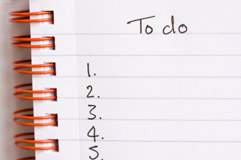 To-do lists are a great way of increasing productivity. It’s easy to become overwhelmed by the tasks we have to do during the course of a week, but we can eliminate stress by creating achievable goals. If you take the time to write down the tasks you need to complete, you will find that the list will help you to put your workload in perspective and keep the end in sight.
 Have you ever been told you can be ‘read like a book’? Are you aware when your body language is ‘leaking’, or giving you away? Words are only a very small part of communication: while you are saying the words, your body is speaking volumes! Sometimes, you don’t even have to say anything: your face or body language will have said it for you! So, if you want to make sure you send all your messages in the way you intend them, here are the top ten tips to help you:
.jpg) Good organisation is all about planning ahead and preparing effectively. When we organise things well, we make the best and most economic use of our time and skills and we also have the satisfaction of having dealt with things with clarity of thought and purpose.
 Most people do not read minutes particularly carefully. They were either at the meeting and so only need a quick reminder of the discussions and action points or they were not there and therefore just need an overview and, once again, action points. So it is essential that the minutes can be skim-read and understood at first reading. Here are the top 10 tips to make your minutes understandable: